IT and Network Infrastructure
Our offered services are provided in the best possible manner as per requirements of the different industrial specifications.
The integration of Audio-Visual systems with IT networks—widely known as AV-over-IP (Audio-Visual over Internet Protocol) is the biggest technological shift the AV industry has seen in the last decade.
In the past, AV systems relied on dedicated, point-to-point cables (like VGA, HDMI, or HDBaseT) and massive, expensive hardware boxes called "Matrix Switchers" to route a video signal from a laptop to a projector.
Today, AV signals are converted into standard data packets and sent across the exact same network infrastructure used for emails and web browsing.
The Core AV-over-IP Components
Instead of plugging a cable directly from a computer to a TV, AV-over-IP uses network edge devices to translate the signals.
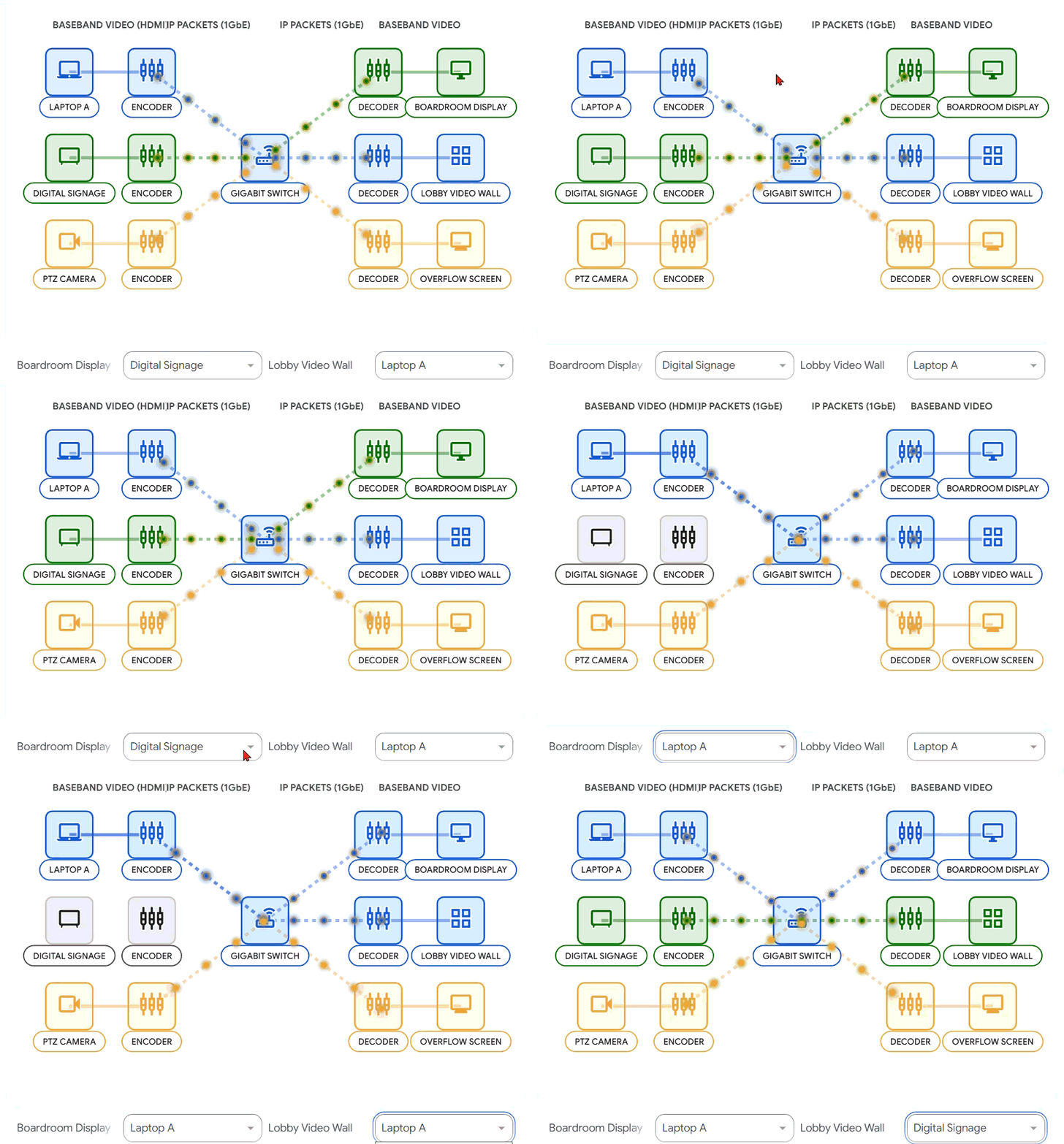
Encoders (Transmitters): These sit at the source (e.g., a meeting room PC, a PTZ camera, or a digital signage player). They take the raw HDMI or audio signal and encode it into standard IP network packets.
Decoders (Receivers): These sit at the destination (e.g., behind a TV, an LED video wall, or connected to an audio amplifier). They receive the IP packets from the network, decode them, and output a standard HDMI or audio signal to the screen or speaker.
The Network Switch: This replaces the traditional, expensive AV Matrix. It acts as the central traffic cop, receiving packets from all the encoders and routing them to the correct decoders.
Crucial Network Requirements for AV
You cannot just plug AV equipment into any standard office network switch; AV traffic is incredibly heavy and constant. AV integrators must configure the IT infrastructure with specific protocols:
High Bandwidth: Uncompressed 4K video requires massive bandwidth. AV networks typically require at least 1 Gigabit (1GbE) switches, and high-end installations often require 10 Gigabit (10GbE) or even fiber-optic backbones.
Multicasting & IGMP Snooping: If a CEO is broadcasting a town hall to 50 TVs across a campus, the network doesn't send 50 separate video streams (which would crash the network). It sends one stream (Multicast), and the switch copies it only to the specific ports that ask for it. This requires a protocol called IGMP Snooping.PoE (Power over Ethernet): Just like security cameras, modern AV encoders, decoders, and touch-panels draw their electrical power directly from the CAT6 network cable, eliminating the need for bulky power adapters behind every TV.
Why the Shift to Networked AV?
Infinite Scalability: A traditional HDMI matrix switcher has a fixed number of ports (e.g., 8 inputs and 8 outputs). If you need a 9th, you have to buy a whole new box. With AV-over-IP, if you add a new TV, you simply buy one decoder and plug it into any available port on the building's network.
Distance Limitations Broken: HDMI cables start failing after 15 meters. By putting AV on the IP network, signals can travel 100 meters over standard CAT6 copper, or multiple kilometers over fiber optic cables, allowing centralized control of a massive university or corporate campus.